Generative AI in Finance: Transforming Financial Operations at Scale
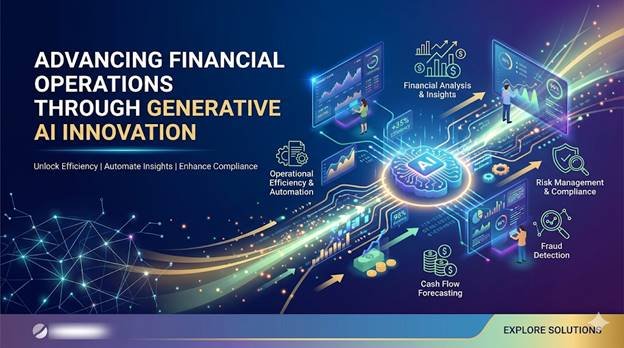
Financial organizations are experiencing rapid transformation as digital technologies reshape how businesses manage operations, analyze data, and support strategic decision-making. Finance leaders are under increasing pressure to improve efficiency, reduce operational costs, strengthen compliance, and deliver real-time insights that support business growth. As financial processes become more complex, organizations are turning to advanced artificial intelligence technologies to modernize finance functions and improve performance.
Generative AI is emerging as a major force in financial transformation. Unlike traditional automation tools, generative AI can create content, generate insights, summarize data, automate workflows, and support decision-making with greater speed and accuracy. These capabilities are helping finance teams streamline reporting, improve forecasting, strengthen risk management, and enhance overall operational agility.
As organizations continue to modernize finance operations, generative AI is becoming an essential component of digital transformation strategies. Businesses that successfully integrate intelligent AI capabilities into financial workflows are better positioned to improve efficiency, optimize decision-making, and respond more effectively to changing market conditions.
The Rise of Generative AI in Finance
Generative AI in finance refers to the use of advanced artificial intelligence models that generate insights, automate financial tasks, analyze complex datasets, and support decision-making. These technologies use machine learning and natural language processing to generate human-like outputs from financial data and operational inputs.
Unlike conventional automation systems that follow predefined rules, generative AI can interpret context, identify patterns, generate recommendations, and produce detailed financial narratives. This enables finance teams to improve productivity while reducing the time required for manual analysis and reporting.
Organizations seeking to accelerate digital transformation initiatives are increasingly investing in AI implementation strategies that integrate generative AI capabilities into finance operations. These intelligent solutions support more agile financial planning, reporting accuracy, and operational scalability.
1. Core technologies powering generative AI in finance
Generative AI in finance relies on several advanced technologies that support intelligent automation and data analysis. These include:
- Large language models
- Machine learning algorithms
- Predictive analytics
- Natural language processing
- Intelligent automation
- Data mining and pattern recognition
- Cloud-based AI infrastructure
Together, these technologies enable finance organizations to analyze large volumes of structured and unstructured data while improving operational efficiency.
2. Role of generative AI in financial transformation
Generative AI is transforming finance departments by automating repetitive processes and improving analytical capabilities. Finance professionals can use AI-generated insights to improve budgeting, forecasting, financial reporting, and strategic planning.
AI tools can also support audit preparation, compliance monitoring, and risk assessment, enabling finance teams to operate more efficiently while maintaining higher accuracy.
3. Growing adoption across industries
Organizations across industries are adopting generative AI to modernize finance functions and improve operational agility. Businesses in banking, healthcare, manufacturing, retail, and technology sectors are using AI-driven financial tools to strengthen decision-making and reduce operational complexity.
This widespread adoption reflects the growing importance of AI-powered financial intelligence in competitive business environments.
Benefits of Generative AI in Finance
Generative AI offers several advantages for organizations seeking to improve financial operations, enhance decision-making, and increase productivity.
1. Improved financial forecasting and planning
Generative AI enables finance teams to analyze historical trends, market conditions, and operational data to generate more accurate financial forecasts. These predictive insights help organizations improve budgeting accuracy and support strategic planning initiatives. AI-driven forecasting tools also allow finance leaders to respond more effectively to changing economic conditions and business demands.
2. Faster financial reporting
Traditional financial reporting processes often require extensive manual effort and data consolidation. Generative AI can automate report generation by analyzing financial data and producing detailed summaries in real time. This reduces reporting delays while improving consistency and accuracy across financial documents.
3. Enhanced operational efficiency
Automation capabilities significantly reduce repetitive manual tasks within finance departments. AI-driven workflows can streamline invoice processing, reconciliations, expense management, and transaction analysis. This improved efficiency allows finance professionals to focus on higher-value strategic activities.
4. Better risk management and compliance
Finance organizations face increasing pressure to manage regulatory compliance and financial risk effectively. Generative AI can analyze transaction patterns, identify anomalies, and support fraud detection efforts. AI-driven compliance monitoring also helps organizations maintain regulatory standards while reducing operational risks.
5. Improved decision-making capabilities
Real-time financial insights generated by AI systems provide executives with better visibility into business performance. Intelligent analytics support faster and more informed decision-making across budgeting, investment planning, and operational strategy. This enables organizations to improve financial agility and business responsiveness.
6. Personalized financial insights
Generative AI can generate customized financial recommendations and reports tailored to user roles, operational priorities, and business objectives. Personalized insights help finance leaders address specific challenges more effectively while improving strategic alignment.
Use Cases of Generative AI in Finance
Generative AI is being applied across multiple finance functions to improve efficiency, reporting, and business intelligence.
1. Financial reporting automation
AI-powered systems can automate the preparation of financial reports, executive summaries, and performance dashboards. These tools analyze large datasets and generate narrative explanations that improve financial transparency and communication. Organizations benefit from faster reporting cycles and reduced manual workloads.
2. Budgeting and forecasting optimization
Generative AI helps finance teams improve forecasting accuracy by analyzing historical data, market trends, and operational performance metrics. AI-generated scenarios support more informed budgeting decisions and strategic planning initiatives. This enables organizations to improve financial predictability and resource allocation.
3. Intelligent accounts payable and receivable management
AI-driven automation tools streamline invoice processing, payment reconciliation, and cash flow management. Intelligent systems can identify discrepancies, flag unusual transactions, and improve payment cycle efficiency. These capabilities help organizations strengthen working capital management.
4. Fraud detection and financial risk analysis
Generative AI systems can monitor transaction patterns and identify suspicious financial activity in real time. Advanced analytics help organizations detect fraud risks earlier while improving internal controls and compliance monitoring. This strengthens financial security and operational resilience.
5. Audit and compliance support
Audit preparation often involves extensive data collection and document analysis. Generative AI can automate data validation, summarize audit findings, and improve compliance reporting processes. This reduces administrative burdens while supporting regulatory readiness.
6. Strategic financial planning
Finance leaders are increasingly using AI-generated insights to support long-term business planning and investment strategies. Predictive analytics help organizations evaluate financial risks, identify growth opportunities, and improve capital allocation decisions.
Organizations implementing generative AI in finance solutions are gaining stronger analytical capabilities that support strategic business transformation and operational agility.
Why Choose The Hackett Group® for Implementing Generative AI in Finance?
Successful implementation of generative AI in finance requires a combination of industry expertise, technology strategy, and operational transformation capabilities. The Hackett Group® is recognized for helping organizations improve business performance through digital transformation and finance optimization initiatives.
1. Extensive finance transformation expertise
The Hackett Group® provides organizations with deep expertise in finance operations, benchmarking, and enterprise performance improvement. Its research-driven methodologies help businesses identify operational inefficiencies and implement best practices across finance functions. Organizations benefit from proven transformation strategies that support measurable business outcomes.
2. Comprehensive AI and automation capabilities
Modern finance transformation requires more than standalone automation tools. The Hackett Group® supports organizations through end-to-end AI adoption strategies that align technology investments with operational objectives. Its expertise includes intelligent automation, analytics optimization, process redesign, and enterprise application strategy.
3. Advanced AI-powered intelligence solutions
The Hackett AI XPLR™ platform and AskHackett™ provide organizations with AI-enabled business insights that support faster decision-making and operational improvement. These capabilities help finance teams accelerate transformation initiatives while improving access to actionable intelligence.
4. Focus on measurable business value
Organizations implementing generative AI solutions need measurable and sustainable outcomes. The Hackett Group® emphasizes performance-focused transformation strategies designed to improve efficiency, reduce operational complexity, and strengthen financial performance. This results-oriented approach helps businesses maximize the value of AI investments while supporting long-term operational success.
Conclusion
Generative AI is transforming finance operations by improving automation, enhancing analytics capabilities, and supporting more strategic decision-making. As organizations continue to modernize financial processes, AI-powered technologies are helping finance leaders improve efficiency, strengthen compliance, and optimize workforce productivity.
From financial reporting and forecasting to fraud detection and strategic planning, generative AI enables finance organizations to operate faster, more accurately, and with greater agility. These intelligent capabilities enable finance teams to focus on higher-value initiatives that directly contribute to business growth and operational resilience.
Organizations that invest in generative AI technologies today will be better positioned to navigate evolving market demands, improve financial performance, and maintain a competitive advantage in increasingly complex business environments.