What Researchers Still Want to Learn About Recovery Medications
When a treatment is described as emerging, it means researchers still have important questions to answer, and understanding those open questions is part of interpreting the field honestly. Knowing what is not yet known is as valuable as knowing what is. The science behind GLP 1 for addiction, an off-label and still-developing area, has genuine promise alongside significant unanswered questions. Emerging research is defined by what remains uncertain. Here is what researchers still want to learn.
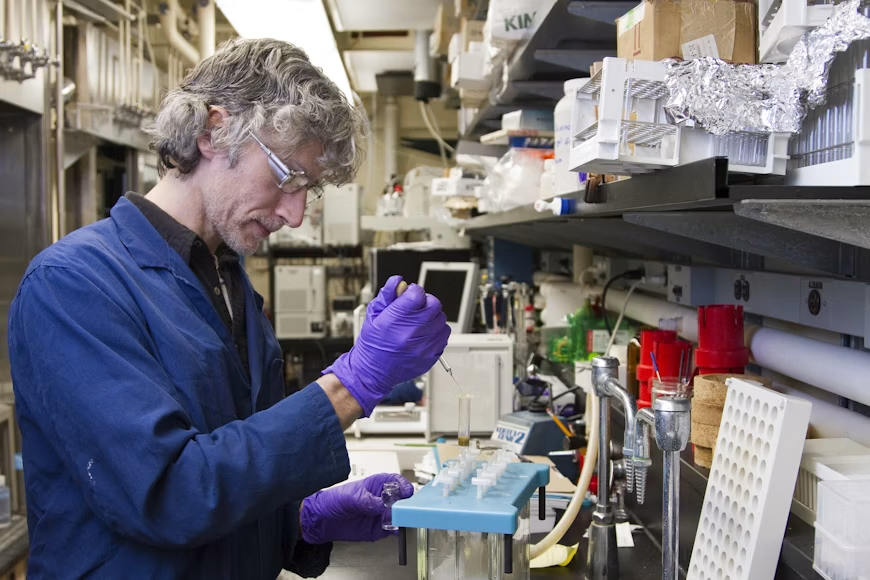
An emerging treatment is one with real open questions. Understanding what researchers still want to learn is key to interpreting the field with honesty.
Does the effect hold up in larger studies?
One of the central questions is whether early, promising findings hold up in larger, more rigorous studies. Early research may show encouraging signals, but these need to be confirmed in bigger trials with proper controls before firm conclusions can be drawn. Researchers want to know whether the effects seen so far are real, consistent, and meaningful across many people, or whether they fade under closer scrutiny. This is a fundamental open question.
This question sits at the heart of the field’s uncertainty. Until larger, well-designed studies confirm early signals, the effects remain promising possibilities rather than established facts, which is why caution is warranted.
Who might benefit, and who might not?
Another key question is which individuals, if any, might benefit. Addiction is complex and varies from person to person, and researchers want to understand whether certain people respond better than others, and why. Questions about different substances, different patterns of use, and individual differences all remain open. Understanding who might be helped, and who might not be, is essential before any treatment could be used responsibly and appropriately.
These questions about individual variation are genuinely important. A treatment that helps some people may do little for others, and understanding these differences is part of what rigorous research must eventually clarify.
What about long-term safety and effects?
Long-term safety and effects are another major open question. While the short-term effects of these medications are relatively well understood from their approved uses, their long-term use in the context of addiction is far less studied. Researchers want to understand the effects of extended use, any risks that emerge over time, and how the medications fit into long-term recovery. These questions require time and careful study to answer.
This focus on long-term effects reflects responsible science. Understanding how a treatment behaves over months and years, not just weeks, is essential before it can be considered well established, and this knowledge simply takes time to accumulate.
How does it fit with everything else?
Researchers also want to understand how these medications fit alongside the rest of addiction treatment. Addiction care involves therapy, support, and addressing underlying issues, and any medication would be one part of a larger picture. Questions about how medication and other elements of treatment work together, and how to integrate them most effectively, remain open. This integration is crucial for responsible use.
This question underscores that no medication is a standalone answer. Understanding how an emerging option fits within comprehensive care is part of what must be worked out before it can be used well. A pill, even a promising one, is never a substitute for the fuller work of recovery.
Why unanswered questions are not a weakness
It is worth emphasizing that open questions are a normal and healthy feature of science, not a flaw. Every established treatment was once emerging, with its own list of unanswered questions that research gradually resolved. The presence of open questions simply marks where a field currently stands on its journey toward understanding. Far from undermining the research, honest acknowledgment of what remains unknown is a sign of scientific integrity.
This perspective helps a person read the field wisely. Rather than seeing uncertainty as a reason to dismiss or to over-trust the research, they can appreciate it as the natural state of an area still being carefully explored. Uncertainty is not a red flag but a normal stage on the road to understanding.
How honest uncertainty guides good decisions
Understanding the open questions actually helps a person make better decisions. Knowing what is not yet established encourages appropriate caution, realistic expectations, and reliance on professional guidance rather than hype. A person who understands the uncertainty is better positioned to weigh an emerging option sensibly, neither dismissing it out of hand nor placing unfounded confidence in it. Honest uncertainty is a foundation for sound judgment.
This is the practical value of acknowledging open questions. It equips a person to approach an emerging area with the balanced, grounded mindset that leads to wiser choices, guided by professionals rather than by premature conclusions. Weighing GLP 1 for addiction this way is exactly how a thoughtful person handles unsettled science.
Frequently Asked Questions
Why are there still so many open questions?
Because this is an emerging, off-label area of research. Early findings are promising but need confirmation in larger, rigorous studies. Being described as emerging means researchers still have important questions to answer, and knowing what is not yet known is as valuable as knowing what is.
What is the most important thing researchers want to learn?
A central question is whether early promising findings hold up in larger, more rigorous studies with proper controls. Alongside this, researchers want to understand who might benefit, long-term safety and effects, and how any medication fits alongside therapy and the rest of comprehensive addiction care.
Does this uncertainty mean the research is not worthwhile?
Not at all. Open questions are a normal, healthy part of emerging science. The research is genuinely interesting and worth pursuing carefully. The uncertainty simply means conclusions should not be drawn prematurely, and any use remains off-label and under study while these questions are worked out.
Honest acknowledgment of open questions is part of responsibly following where GLP 1 for addiction may lead as an emerging area.